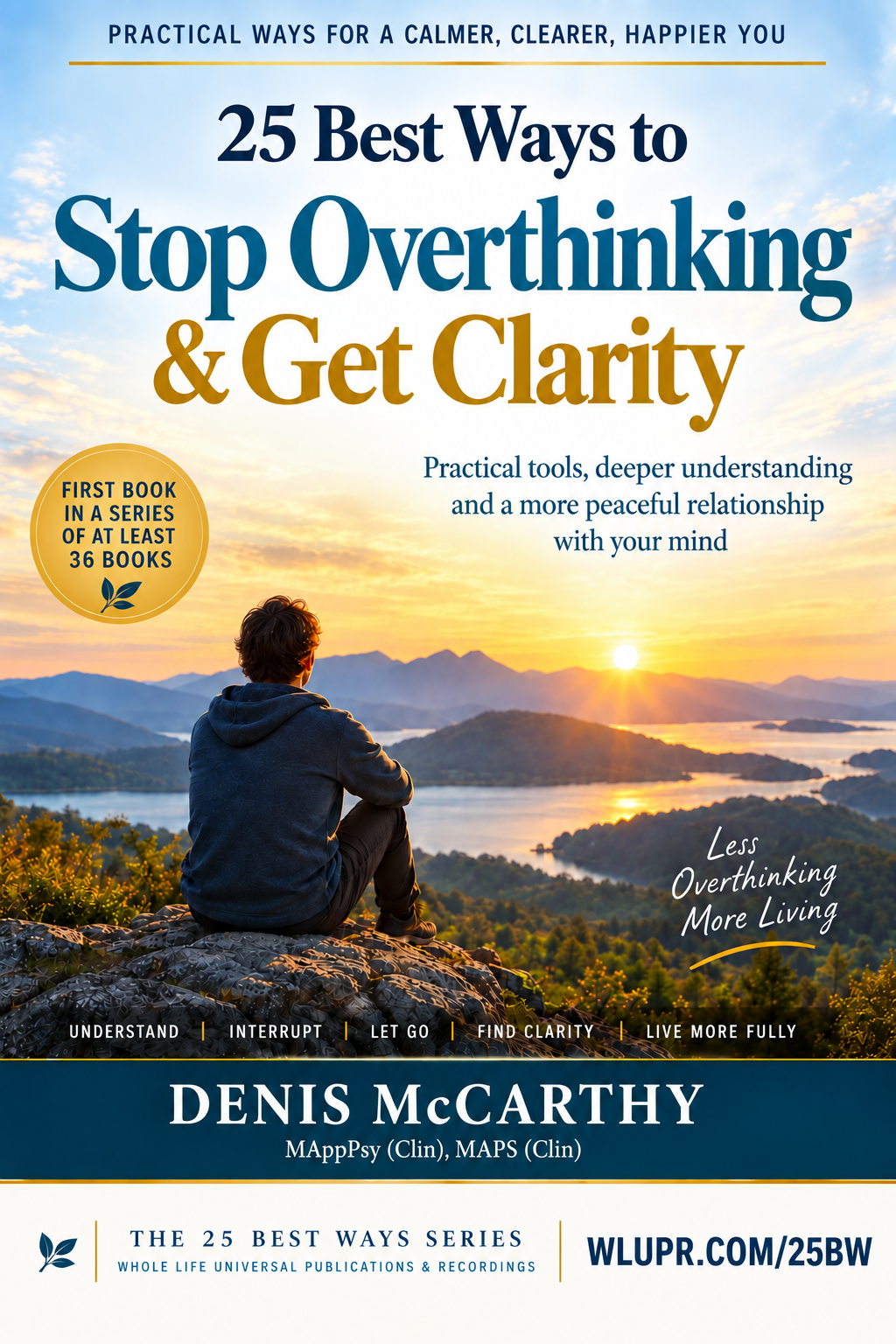
25 Best Ways to Stop Overthinking & Get Clarity
Practical tools, deeper understanding and a more peaceful relationship with your mind.
Thinking is one of our greatest human capacities. It helps us solve problems, anticipate difficulties and make sense of our lives. Yet sometimes thinking stops moving us forward. We revisit the same questions, imagine increasingly difficult possibilities, analyse decisions long after useful reflection has ended, and become caught in mental loops that create more uncertainty rather than less.
“Clarity is not the absence of thought, but the presence of direction.”
When Thinking Stops Helping
Finding your way back to clarity
There is nothing inherently wrong with thinking carefully. Reflection, planning and considering alternatives are essential parts of good judgment. The difficulty begins when thought ceases to produce useful information or purposeful action and instead becomes repetitive.
We may keep asking ourselves whether we made the right decision, replay a conversation to determine what somebody really meant, search for one more piece of information before acting, or try to eliminate every possible uncertainty before moving forward. What begins as an attempt to find clarity can gradually become the very thing preventing it.
25 Best Ways to Stop Overthinking & Get Clarity is not about trying to empty the mind or stop thinking. It is about learning to recognise when thinking is useful, when it has become repetitive, and what you can do when the mind has become caught in an unproductive loop.
Recognising the Pattern
Overthinking can take many forms
The details differ, but many experiences of overthinking share a common pattern: the mind keeps working long after useful thinking has run its course.
Worry
Repeatedly imagining what might go wrong and trying to think your way to complete certainty about the future.
Rumination
Replaying past events, conversations, disappointments or mistakes without reaching a useful resolution.
Analysis Paralysis
Continuing to analyse alternatives because acting feels riskier than gathering still more information.
Perfectionism
Trying to find the perfect answer, perfect decision or perfect performance before allowing yourself to move forward.
Self-Criticism
Repeatedly examining what you should have done differently and treating uncertainty or mistakes as evidence of personal failure.
Information Overload
Searching, comparing and consuming more information even after enough is already available to make a reasonable decision.
The Original 25 Best Ways Framework
25 practical techniques. 25 affirmations.
The expanded book develops the original 25 Best Ways to Stop Overthinking & Get Clarity program into a fuller exploration of how overthinking works and what can help.
Practical Techniques
Twenty-five different ways of responding when overthinking occurs — from recognising the loop and grounding attention to setting decision limits, clearing mental overload, changing your physical state and learning when enough thinking is enough.
Affirmations
A separate collection of twenty-five statements supporting themes such as perspective, self-trust, acceptance, present-moment awareness and the ability to step back from unhelpful mental loops.
Inside the Book
A practical journey from mental loops toward greater clarity
The 25 techniques are explored within ten connected chapters so that readers can understand not only what to do, but why particular approaches may be useful.
Understanding the Overthinking Mind
Recognising when productive reflection has turned into repetitive thinking.
Interrupting the Mental Loop
Using breathing, mindfulness and grounding to create space around repetitive thought.
Getting Thoughts Out of Your Head
Externalising thoughts through writing, scheduled worry and deliberate letting go.
From “What If?” to “What Is?”
Shifting attention from imagined futures toward the reality that can be addressed now.
Fear, Perfectionism and the Inner Critic
Understanding some of the emotional forces that can keep overthinking alive.
Escaping Analysis Paralysis
Learning when to stop gathering information, make a reasonable choice and begin.
Clearing Mental Overload
Reducing unnecessary cognitive demands and creating room for focused attention.
Changing Your State to Change Your Mind
Using movement and creative activity to interrupt mental rigidity and restore flexibility.
Finding Perspective and Trusting Yourself
Seeking perspective without surrendering your own judgment and developing more grounded self-trust.
Living with Greater Clarity
Bringing the 25 techniques together into a personal repertoire for everyday life.
Putting the Affirmations into Practice
More than simply reading positive statements
Your 10-Affirmation Practice
The book concludes the practical program by inviting readers to select ten of the original twenty-five affirmations that seem most personally relevant. These can then be rehearsed as a focused practice rather than simply read once and forgotten.
The approach draws in part upon principles of cognitive fluency while retaining an important distinction: affirmations are not magic formulas, and they do not require us to pretend that difficult thoughts or feelings do not exist. Their value lies in repeatedly bringing useful, believable and purposeful ideas back into attention.
“My thoughts are not facts.”
Who Is This Book For?
For anyone whose mind sometimes works a little too hard
You do not need to think of yourself as an “overthinker” to find these ideas useful. Most of us become caught in repetitive thinking at times, particularly when something matters deeply, when we are uncertain about what to do, or when we are trying very hard not to make a mistake.
The book is written for general readers who want practical psychological ideas they can understand and use. It may be especially relevant if you tend to worry about future possibilities, replay past events, struggle to make decisions, become caught in perfectionism, seek repeated reassurance or find it difficult to switch off from problems once you have begun thinking about them.
The aim is not to promise a permanently quiet mind. It is to help you develop a more flexible relationship with thinking itself — recognising when thought is helping, when it is no longer helping, and how to choose what happens next.
Read · Listen · Explore
Choose the format that works for you
The developing 25 Best Ways publishing program is designed to connect print, digital and audio resources around the same practical themes.
Printed Book
The expanded print edition brings together the practical techniques, psychological explanations, case examples, affirmations and further resources in one accessible volume.
ForthcomingeBook
A digital edition for readers who prefer immediate access across their personal devices.
ForthcomingAudio
Companion audio resources extend the original 25 Best Ways format and provide another way to engage with the practical material.
ForthcomingBook One of a Growing Collection
Discover the 25 Best Ways Series
25 Best Ways to Stop Overthinking & Get Clarity is the first expanded book in a developing collection of at least 36 titles exploring wellbeing, personal growth, relationships, confidence, resilience and purposeful living.
WLUPR.COM/25BWPublished by
Whole Life Universal Publications & Recordings
WLUPR publishes books, eBooks, audio, video and educational resources concerned with human health and wellbeing, psychology, consciousness, sustainability, social transformation and the future of humanity.
WLUPR.COM